3D Point Cloud Annotation: Workflow, Cost per Frame, and How to Choose a Vendor

Your 2D detector works. The bounding boxes are clean, the model runs, and the demo looks good. Then you mount a LiDAR unit, open the first point cloud frame, and the workflow you spent three months refining stops applying. Objects are sparse instead of solid. A pedestrian at 40 meters is nine points. Half the vehicles in the scene are partially hidden behind other vehicles, and there is no longer an obvious “correct” box outline to draw.
The same problems show up whether you are building perception for autonomous vehicles, warehouse robotics, drones, construction site monitoring, or survey and mapping — anywhere a LiDAR sensor produces frames that a model has to learn from.
This guide covers what 3D point cloud annotation actually involves: which annotation types exist, the five steps of building a dataset, what drives cost per frame, where in-house point cloud annotation tends to break down, and how to evaluate an outsourcing partner. It is written for engineers and project managers in autonomous driving, ADAS, and robotics who have shipped 2D annotation before and are now sizing up the 3D version of the same problem.
Table of contents
- When You Actually Need 3D Point Cloud Annotation
- Annotation Types for LiDAR Data
- Building a 3D Point Cloud Dataset: Five Steps
- 1. Collect and sample frames
- 2. Define classes and write the annotation spec
- 3. Annotate
- 4. Convert and split
- 5. Train, evaluate, and go back to the data
- How Much Does 3D LiDAR Annotation Cost per Frame?
- Three Places In-House 3D Annotation Breaks Down
- How to Choose a 3D Point Cloud Annotation Provider
- In-House vs. Outsourcing
- Frequently Asked Questions
| Quick answers | |
|---|---|
| Cost per cuboid | From $0.121 — see what drives cost per frame |
| Choosing a provider | Five criteria — see how to choose |
| Minimum volume | No minimum order; PoCs from around 50 to 100 items |
When You Actually Need 3D Point Cloud Annotation
Not every perception problem needs 3D. Adding LiDAR to a project that a camera could have handled multiplies your data cost for no gain, so the first decision is whether you need it at all.
2D image annotation is usually enough when your model only needs to answer “is this object present, and where is it in the image?” Classification, counting, defect detection on a fixed camera, and most retail or inspection use cases fall here. If you are at this stage, our guide to creating training data for YOLO covers the 2D workflow end to end.
You need 3D point cloud annotation when the model has to answer “how far away, how big, which direction is it facing, and where will it be next?” Metric distance and heading cannot be recovered reliably from a single 2D box. Concretely:
- Autonomous driving and ADAS. Path planning needs the distance and orientation of every vehicle, pedestrian, and cyclist in metric space, not pixel space. Braking decisions depend on it.
- Robotics. Point cloud annotation for robotics AI supports navigation, obstacle avoidance, and grasping, where the robot needs the geometry of free space as much as the identity of objects.
- Infrastructure and site inspection. Aerial or terrestrial LiDAR scans of roads, bridges, power lines, and construction sites, where measurement is the output.
- Night, glare, and adverse weather. LiDAR does not depend on ambient light, so datasets covering these conditions often rely on it where a camera-only dataset would fail.
A useful middle case: some teams start with 2D annotation on the camera stream, confirm the model concept works, and only then extend to LiDAR point cloud annotation on the same scenes. That sequencing keeps early costs low and is worth considering before committing to a 3D dataset.
Annotation Types for LiDAR Data
“3D annotation” is not one task. The four types below have very different labor profiles, and mixing them into a single project without deciding which you need is one of the most common ways a budget gets away from a team.
| Type | What it produces | Typical use | Relative effort |
|---|---|---|---|
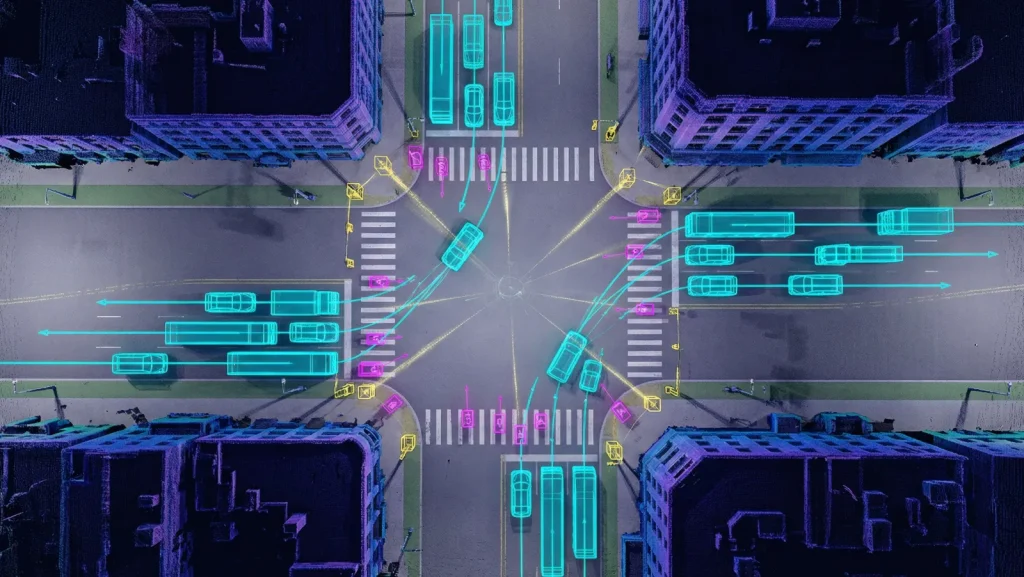
| 3D cuboid | An oriented 3D box per object: position, dimensions, and heading angle | Object detection and distance estimation for vehicles, pedestrians, cyclists | Moderate |
| 3D semantic segmentation | A class label on every individual point | Drivable surface, ground plane, vegetation, buildings | High |
| Object tracking IDs | A consistent instance ID for the same object across consecutive frames | Motion prediction, tracking evaluation, sequence models | Moderate, but scales with sequence length |
| Sensor fusion (LiDAR + camera) | Linked instances across the point cloud and the synchronized image | Fusion perception models, cross-sensor validation | High |
3D cuboid annotation services are the entry point for most detection projects and the type teams request first. Segmentation is where the per-frame labor climbs steeply, because the unit of work moves from “one box per object” to “every point in the scene.” If you are weighing the same question in 2D, the trade-off is structurally identical and covered in our semantic segmentation annotation guide.
Tracking IDs deserve a specific warning. Annotating 200 isolated frames and annotating a 200-frame continuous sequence with persistent IDs are not the same job, even though the frame count matches. The second requires the annotator to hold object identity across occlusion events, and it costs meaningfully more. Decide which you need before you request a quote.
3D Point Cloud & LiDAR AnnotationLiDAR annotation services for autonomous driving, robotics and surveying: 3D cuboids, segmentation and sensor fusion. Full-volume QA, from $0.121 per cuboid.annotation-support.com
Building a 3D Point Cloud Dataset: Five Steps
1. Collect and sample frames
A LiDAR sensor running at 10 Hz produces 36,000 frames per hour of driving. Annotating all of them is neither affordable nor useful, because consecutive frames are highly redundant.
Sample instead. Take keyframes at a fixed interval, then deliberately oversample the situations your model will fail on: intersections, merges, dense pedestrian crossings, night, rain, and unusual objects. A dataset of 1,000 well-chosen frames will beat 10,000 frames of empty highway. Scene diversity, not frame count, is what moves accuracy.
2. Define classes and write the annotation spec
This is the single highest-leverage step, and the one teams consistently under-invest in. In 3D, three questions cause almost all of the spec drift you will encounter later:
- Occlusion. A vehicle is 60% hidden behind a truck. Do you box the visible points only, or do you extrapolate the full vehicle extent from the visible portion? Both are defensible. Only one can be in your dataset.
- Sparse distant objects. At what point does an object have too few points to label? Define a minimum point count or a maximum range, and state it explicitly. “Use your judgment” guarantees inconsistency.
- The ground plane. Does a cuboid extend down to the road surface, or does it stop at the lowest returned point on the object? Wheel-level returns are noisy, and this choice shifts every box in the dataset.
Write the answers down, with annotated example frames showing the edge cases. A spec with pictures resolves disputes that a spec with prose does not.
3. Annotate
Work in a point cloud annotation tool that supports oriented cuboid fitting, multi-view panels (top-down, front, side), and frame-to-frame interpolation. Interpolation matters more in 3D than in 2D: annotating an object at frame 1 and frame 20 and letting the tool interpolate the intermediate poses removes a large share of the manual work in sequence projects. Open-source and commercial options both exist, and the right choice depends on whether you need sensor fusion views and how your team handles review. We will cover tool selection in detail in a follow-up article.
Whichever tool you use, plan the review pass at the same time as the annotation pass. In 3D point cloud labeling, review is not a formality — see the cost section below.
4. Convert and split
Export to a format your training pipeline already reads. KITTI and nuScenes are the common public conventions, and most detection frameworks ingest one or both. Confirm two things before you export at scale: the coordinate convention (which axis points forward, where the origin sits) and the heading angle convention. A 90-degree systematic rotation error is easy to introduce and hard to notice until your evaluation numbers are inexplicably poor.
Split train, validation, and test by scene or by drive, never by randomly shuffling individual frames. Consecutive frames from the same drive are near-duplicates; shuffling them puts near-identical data on both sides of the split and produces an evaluation score that flatters your model and will not survive deployment.
5. Train, evaluate, and go back to the data
Train a baseline on the smallest dataset that could plausibly work, then look at the failure cases before annotating more. In 3D, failures cluster into recognizable groups: distant objects, heavily occluded objects, and rare classes. Each of those points at a specific gap — in your sampling, in your spec, or in class balance — and fixing the gap is usually cheaper than adding volume indiscriminately. Expect to revise the spec at least once after the first training run. That is normal, not a planning failure.
How Much Does 3D LiDAR Annotation Cost per Frame?
There is no single per-frame price, because a “frame” is not a fixed unit of work. A highway frame with four vehicles and an intersection frame with forty vehicles and pedestrians differ by an order of magnitude in labor while both counting as one frame.
Pricing at ANOSUPO is per annotated object, not per frame, and billing is fully usage-based with no setup fee, no management fee, and no minimum order:
| Type | Unit price (excl. tax) |
|---|---|
| 3D cuboid (LiDAR) | from $0.121 / cuboid |
| Bounding box (2D object detection) | from $0.036 / label |
| Segmentation (2D region) | from $0.152 / region |
| Keypoint (pose estimation) | from $0.021 / point |
The 2D rates are shown for comparison: a 3D cuboid carries roughly three times the unit price of a 2D bounding box, which reflects the additional work of fitting depth, extent, and heading rather than a rectangle. Your effective cost per frame is therefore the object count in that frame multiplied by the unit rate, adjusted for the factors below. At the entry rate of $0.121 per cuboid, the highway frame above works out to about $0.48 and the intersection frame to about $4.84 — a tenfold difference for the same single frame, which is why frame count alone is a poor basis for a budget.
What moves the number:
- Objects per frame. The dominant factor. Scene density drives cost more than anything else on this list.
- Class count and attributes. Five classes with occlusion flags and heading precision requirements cost more per object than two classes with no attributes.
- Tracking across frames. Persistent IDs through occlusion add work that isolated-frame annotation does not have.
- Sensor fusion. Linking each 3D instance to its camera counterpart adds a second pass over the same objects.
- Inspection standard. Full-volume inspection costs more than spot-checking a sample, and produces a materially different dataset.
For current published rates across all annotation types, see our pricing page. For a number specific to your sensor setup, scene density, and spec, request a quote — we can estimate from a handful of representative frames.
PricingTransparent annotation pricing — Bbox from $0.036/label, keypoints from $0.021/point, segmentation from $0.152/region, 3D cuboids from $0.121, LLM evaluation from $0.121. $0 setup, fully usage-based, no minimum order.annotation-support.com
Three Places In-House 3D Annotation Breaks Down
Teams that successfully ran 2D annotation in-house often assume 3D is the same job with an extra axis. Three things are different, and each one has ended 3D annotation projects.
1. Occlusion rules fracture between annotators. In 2D, the outline of an object is visible and two annotators mostly agree. In 3D, a partially occluded vehicle has no observable “true” extent, so annotators infer it — and they infer it differently. The result is low inter-annotator agreement on exactly the cases your model most needs to get right. This is a specification problem, not a diligence problem, and it does not resolve by asking people to be more careful.
2. Inspection is heavy, and sampling does not work. Reviewing a 2D box is a glance. Reviewing a 3D cuboid means rotating the scene, checking the top-down view, checking the side view, and confirming the heading. Because 3D errors are systematic rather than random — a misunderstood occlusion rule affects every occluded object in the batch — inspecting a 10% sample tells you very little. You either inspect everything or you accept unknown quality. ANOSUPO uses full-volume inspection rather than sampling, with 99.7% quality consistency, and corrects any defect attributable to us against the agreed specification free of charge for one year after delivery.
3. Engineering time disappears into labeling. The engineers who understand the spec well enough to annotate correctly are the engineers who should be training models. In 3D, per-frame labor is high enough that this trade becomes expensive fast, and it is rarely visible in a budget line.
How to Choose a 3D Point Cloud Annotation Provider
Many vendors that offer image annotation list 3D as a capability without having run it at volume. Use this checklist when evaluating any 3D point cloud annotation company:
- Which 3D types can they actually deliver? Ask specifically about cuboids, point-level segmentation, cross-frame tracking IDs, and sensor fusion. These are four different capabilities. A provider handling cuboids well may have no segmentation workflow at all.
- How do they inspect? Full-volume or sampling? If sampling, at what rate, and what happens when a systematic spec error is found in the sample — is the whole batch reworked?
- How is security handled? Vehicle and site data typically contains public spaces, faces, and license plates, and is often commercially sensitive as well. Look for a certified framework rather than assurances. ANOSUPO is certified to ISO/IEC 27001 (ISMS), operates cloud-only with no local retention, has NDAs with all staff, separates teams per project, never reuses client data to train our own models, and physically deletes data at project close. Details are on our security page.
- How do they bill? Setup fees, management fees, and minimum order volumes change the economics of a first project far more than the unit rate does.
- Can you start small? A provider confident in their work will annotate a sample of your real data before you commit. If a vendor requires a large minimum commitment to begin, you cannot evaluate them on your own data — only on their marketing.
- Do they engage with your spec? The best signal in a first conversation is whether the provider asks about occlusion handling, ground-plane convention, and minimum point thresholds. Providers who ask these questions have annotated point clouds. Providers who only ask for frame counts have not.
Comparing 3D point cloud annotation companies on unit price alone is a mistake, because unit price is only meaningful once the spec and inspection standard are held constant. A lower per-cuboid rate with sampled inspection and no rework guarantee can easily cost more once you account for the model retraining that follows a bad batch.
3D point cloud work narrows your vendor options considerably. Our data annotation outsourcing guide lists seven criteria for evaluating an annotation partner.
In-House vs. Outsourcing
Neither answer is universally correct. The split usually follows project stage.
| In-house | Outsourcing | |
|---|---|---|
| Best when | Spec is still changing weekly; volume is small; domain knowledge is rare and hard to transfer | Spec is stable; volume is beyond team capacity; the bottleneck is labeling, not modeling |
| Spec control | Immediate — you change it in a conversation | Requires a written spec and a revision cycle |
| Scaling | Limited by headcount; hiring and training take months | Scales with the provider’s capacity |
| Real cost | Engineer salary time, often unbudgeted | Visible per-object cost |
| Consistency risk | High on occlusion and edge cases without a formal review pass | Depends entirely on the provider’s inspection standard |
A common and effective pattern: keep the first few hundred frames in-house to discover what your spec actually needs to say, then hand the stable spec and the volume to a partner. The in-house phase is spec development, not data production.
Our 3D LiDAR annotation services cover cuboids, point cloud segmentation, cross-frame tracking, and sensor fusion — see our LiDAR annotation services page for scope. For research and robotics projects where the task does not fit a standard workflow, our OMRON SINIC X case study describes a complex, specialized annotation task handled with a purpose-built interface.
Complex, specialized annotation handled with custom UIs and flexibilityHow ANOSUPO walked alongside OMRON SINIC X's AI research through annotation — flexible handling of specialized tasks, custom UI design, and a sharp cut in dataset creation time.annotation-support.com
Frequently Asked Questions
Which provider should I choose for LiDAR and point-cloud annotation for autonomous systems?
Evaluate on four things rather than price alone: which 3D types the provider can actually deliver (cuboids, segmentation, tracking IDs, sensor fusion), whether inspection is full-volume or sampled, whether security is backed by certification such as ISO/IEC 27001, and whether you can run a small paid or free pilot on your own data before committing. A provider who asks you about occlusion rules and ground-plane conventions in the first conversation has done this work before.
How is 3D annotation priced compared to 2D bounding boxes?
Per object in both cases, but at a higher unit rate in 3D. A 3D cuboid starts from $0.121 per cuboid against $0.036 per label for a 2D bounding box, reflecting the extra work of establishing depth, extent, and heading. Because 3D scenes often contain many objects per frame, object count per frame matters more to your total than the unit rate does.
Can you handle sensor fusion (LiDAR + camera)?
Yes. We annotate LiDAR point clouds and synchronized camera images with linked instances, so each 3D object corresponds to its 2D counterpart. Fusion work costs more per object than cuboids alone because it requires a second pass over the same objects, so it is worth confirming early whether your model architecture actually needs linked labels.
How small can a first project be?
There is no minimum order. We recommend starting with a small set of representative frames — including the difficult scenes, not just the clean ones — to validate the specification before scaling. We also offer a free trial in which we annotate roughly 10 to 50 items of your real data with our production team, so you can assess quality before placing an order.
How is our data protected?
ANOSUPO is certified to ISO/IEC 27001 (ISMS). We work cloud-only with no local retention, hold NDAs with all staff, separate teams per project, never reuse client data to train our own models, and physically delete data once a project closes. Full details are on our security page.
Getting Started
3D point cloud annotation is not 2D annotation with an extra axis. The specification questions are harder, inspection is heavier, and per-frame labor is high enough that decisions made early — what to sample, how to handle occlusion, whether you need tracking or fusion — determine your budget more than any unit rate does.
The practical starting point is small: pick a few dozen representative frames including the hard scenes, write the spec down with example images, and annotate them. You will learn more about what your dataset needs from those frames than from any amount of planning. From there, the decision of what to keep in-house and what to hand off becomes a straightforward one.
If you would like a second opinion on your spec, or a cost estimate based on your actual frames, we are happy to look at them with you.
Try our quality on your own data — for free.